



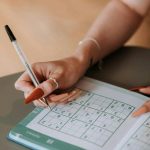
Lifting a jigsaw piece off the table looks like one action. It is closer to four running at once: a precision grip between thumb and index finger, a stabilised wrist holding the hand at a usable angle, a forearm rotation to present the piece at the orientation you want to inspect, and a second hand doing something entirely different, usually holding the assembled section still. That combination is why puzzles turn up so often in discussions of dexterity.
What fine motor skill actually refers to
The term covers more than finger strength. A paper in the American Journal of Human Biology describes fine motor skills in school children as an interplay of spatio-temporal processing, visuo-motor integration, strength control, perceptual and cognitive skills, alongside dexterity and manipulation of small objects. The same paper notes that cognition and motor skills are interrelated at the level of brain structure, supported by similar cortical substrates.
Two components matter most for puzzling. Visuo-motor integration is the coupling between what you see and what your hand does, which is the whole business of guiding a piece into a gap you are looking at. In-hand manipulation is repositioning an object within one hand without putting it down, which is what you do when you rotate a piece with your fingertips rather than setting it back on the table.
Where puzzles sit in motor development
The precision grip that puzzling depends on develops early. A pincer grasp using thumb and index finger typically emerges around nine months and is generally present by ten months, following a progression from a whole hand power grip at roughly five months. By the time a child is handling chunky wooden inset puzzles, the grip itself is established. What is still developing is control: accuracy of placement, force regulation, and the coordination of two hands doing dissimilar jobs at the same time.
That is a useful distinction, because it clarifies what a puzzle is and is not doing. It is practice at applying a motor skill under visual guidance. It is not building the grasp from nothing.
Touch is worse at flat shapes than you would expect
There is a common assumption that experienced puzzlers read piece shapes by feel. The haptics research suggests real limits on this. Klatzky and Lederman, writing in Philosophical Transactions of the Royal Society B, describe stereotyped hand movements they call exploratory procedures, each suited to a particular property: lateral motion across a surface for texture, and contour following for shape, which they found optimal and necessary for extracting precise shape information.
The relevant complication is dimensionality. The same work reports that three dimensional objects are recognised nearly perfectly by touch, while two dimensional raised line drawings produce dramatic drops in accuracy. A jigsaw piece is close to the difficult case. It is essentially a flat outline, and reading its contour by touch alone is slow and imprecise.
So the honest account is that touch contributes usefully to thickness, edge quality, board finish and whether a join has properly seated, while shape matching remains overwhelmingly visual. This is different for three dimensional mechanical puzzles, where enclosing a piece in the hand genuinely does tell you about its structure.
Piece size, hand size and grip
A few practical points follow from the mechanics rather than from any study.
- Very small pieces force a tighter pinch and more static muscle tension, which is what makes long sessions with micro puzzles tiring in the hands.
- Larger pieces suit small hands and low grip strength, which is why children’s puzzles and accessible ranges use chunky stock.
- Piece thickness matters as much as footprint. A thicker piece gives a purchase point at the edge and is easier to lift without scraping at the table.
- Table height and chair height determine wrist angle, and a poor wrist angle makes every pick up marginally harder for hours.
- Matte finishes are easier to grip than gloss, particularly with dry hands.
An informational note, not advice
Puzzles involve fine motor activity. That much is descriptive and uncontroversial. It does not follow that puzzles are a therapy, and nothing here should be read as saying they treat, improve or rehabilitate any motor condition. The research described above concerns typical motor development and the mechanics of touch, not clinical outcomes.
If you have a specific concern about dexterity, grip strength, hand pain, tremor or coordination, whether for yourself, a child or an older relative, an occupational therapist is the right person to speak to. They assess the actual task demands against the actual difficulty and can adapt an activity properly, which is not something a general article can do.